




Increased uncertainty brought on by our bombing of Iran pushed returns down across the board. Here are the indices data for several periods ending March 31, 2026:
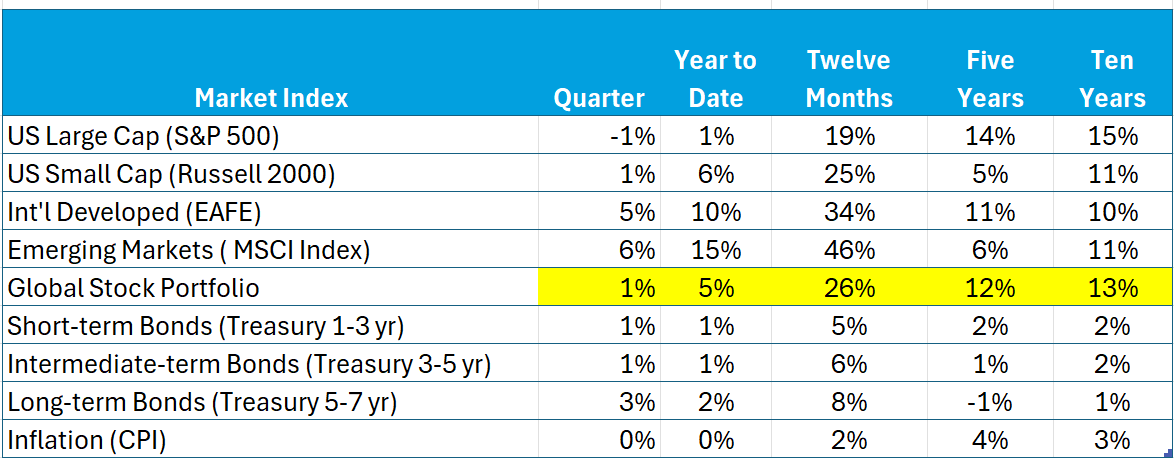
Note especially:
- The negative returns this month across the board, especially emerging markets
- Yet, the returns over past years remain significantly positive
- Results of our global stock portfolio
Stocks
Stock indices were especially volatile in March, ending down across the board with losses ranging from negative 5% – 13%. International markets were down most, dropping between 10% and 13%, giving back some of their recent returns. The value of the dollar is up a bit, explaining some of the shortfall in non-domestic markets. Our global stock portfolio is off 7%.
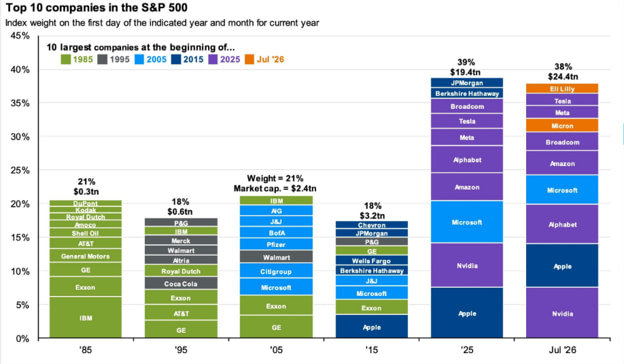
The Magnificent Seven portfolio was off 9% this quarter, explaining most of the falloff in the S&P 500 Index. The other stocks in the S&P 500 essentially broke even over the period.
Much of the movement in the emerging markets index is driven by South Korea. Using MSCI South Korea ETF as a proxy, this market was up 55% in the first two months of the year, then down 20% in March. These results can be explained by the fact that not only is South Korea expected to participate in AI technology, but it is also weighted to more stable HALO (heavy assets, low obsolescence) companies.
The trailing twelve-month returns, which range above 20% – our emerging markets index is above 30% – were absorbed the March falloff.
Ten-year stock indices show us a positive period for stocks. But stock prices reflect the future, which has certainly become murkier recently. While it is reasonable to expect positive results over the long term, we can plan on the need to endure increased volatility.
Bonds
Bond yields jumped nearly half a percent this month – another signal of increased uncertainty in the worldwide economy. Since prices move inversely with yields, bond returns were down in March.
We see a slight uptick in real (inflation-adjusted) yields this month. The spread between real yield and nominal 5-year yields increased to close to 2.5%, which is consistent with increased inflation worries.
Pricing Uncertainty
Market prices reflect the present value of an uncertain future. In a well-functioning market, for every seller there must be a buyer, each with access to the same information set. Prices change as information changes. New information (news) comes randomly and can be both positive and negative. Volatility results. With increased uncertainty the impact of news becomes greater, increasing volatility.
Obviously, markets don’t like uncertainty, which has increased substantially with the bombing in the Middle East. We have been dealing with uncertainty for the future of AI, Fed policies, tariffs, interest rates, deficits, political dysfunction, etc. Our bombing of Iran added energy prices to this mix and brought an abrupt downward shift in values. Of course, a primary question is to what extent markets come back once the bombing ceases. Markets have bounced back throughout the month on positive Middle Eastern news.
March results confirm that markets do go down.To succeed in the long term, It is important to endure these ups and downs and avoid projecting recent results into the future.