





Capital Markets Activity
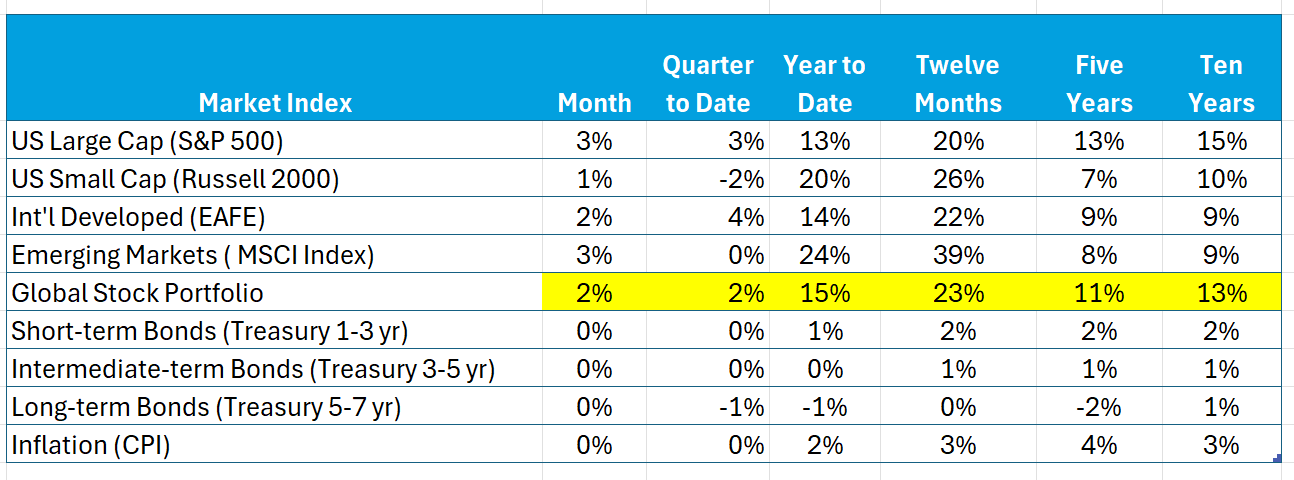
Shrugging off uncertainty, stock market returns are up across the board. Bond yields are up, reflecting increased risk, not longer-term inflation expectations. Rising yields brought on negative bond returns. Here’s the data:
Stock Markets
Amid continued volatility, stocks turned in a good performance in August. Note the consistency of stock market indices. Results were not driven by technology stocks exclusively, as the equally weighted S&P 500 monthly return of 2.1% is comparable to the above capitalization-weighted index.
Year-to-date and trailing-twelve-month returns in emerging markets are explained to a significant extent by the results of two South Korean tech companies: Samsung and SK-Hynix. After a sharp decline in July the stocks of these two companies, which represent 40% of the index, bounced back nicely in August.
While recent periods have been good for stocks, uncertainties have not gone away. These include returns from the substantial investments in Data Centers; resolution of the war with Iran; massive deficits; inflation and the Fed monetary policy; and political dysfunction. How these uncertainties eventually resolve will most certainly impact future stock markets. In the meantime, expect continued volatility.
Bond Markets
With rising yields and the US Government deficit reaching $40 trillion, there is renewed interest in the bond markets. Bond returns close to zero this month are consistent with rising yields.
While expected, inflation over 5- and 10-yr. periods implied by the spread (2.3%) between nominal and inflation-adjusted yields is close to Fed goals, short-term inflation is worrisome providing pressure for the Fed to increase the Federal Funds rate. The new chair, Kevin Warsh, has expressed renewed commitment to combating inflation. Thus, an increase in the Federal Funds rate at its next meeting seems to be baked in. On the other hand, the uncertainty of the future path of interest rates is not helped by the Secretary of the Treasury, Scott Bessett, seeking to drive down longer-term interest rates by intervening in the bond markets.
From a longer perspective, changes in the yield of the bellwether 10-yr. US Treasury security since January 2021, are shown in the accompanying chart. Look at the sharp increase (chart shown below) from unsustainable levels in response to Covid shutdowns earlier in the period. Although it has increased from the first of this year, the 10-yr. yield has remained relatively constant at more typical levels since the initial surge.
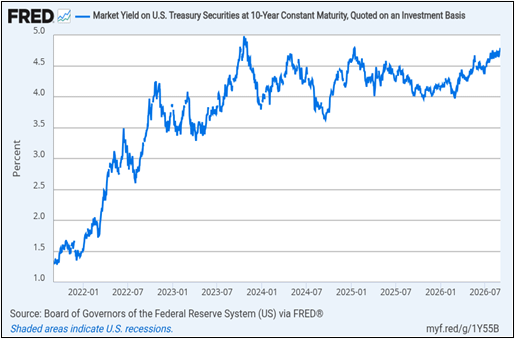
Changes in bond yields are driven by changes in underlying risks, the Fed’s monetary policies, as well as expected inflation. We can disentangle the effects of inflation expectations by looking at the pattern of changes in inflation-adjusted yields of the 10-yr. Treasury security over a comparable period shown below:
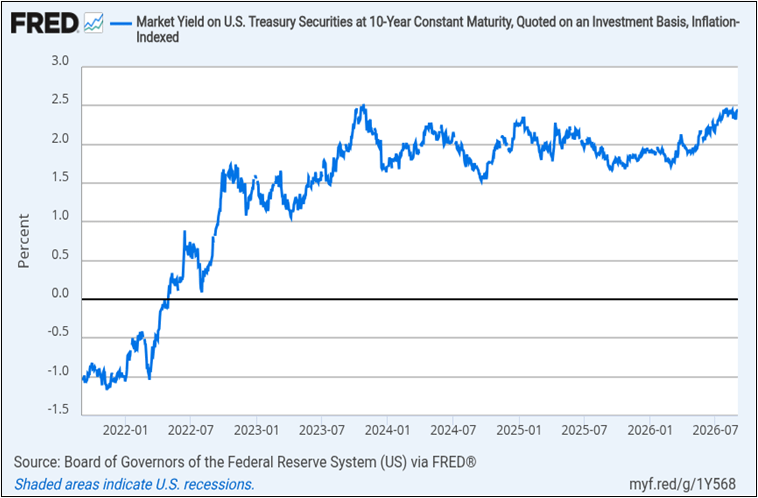
Note that the pattern of yield changes is similar in these two charts, which suggests that it’s expected changes in risks and Fed policies, not inflation, that explain recent changes in yields. Longer-term yields reflect the expected path of short-term rates, which are driven by Fed policies.
The dilemma is to keep inflation in check without affecting economic activity aversely. A fine line that contributes to today’s uncertainties and volatile markets.