



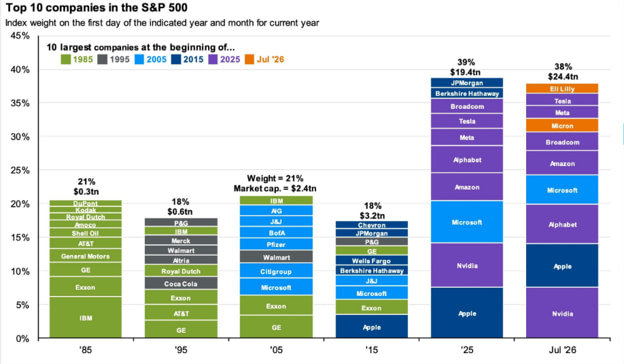


July brought volatile stock markets resulting in mixed returns among various indices. Bond yields are up, reflecting increased risk producing negative bond returns.
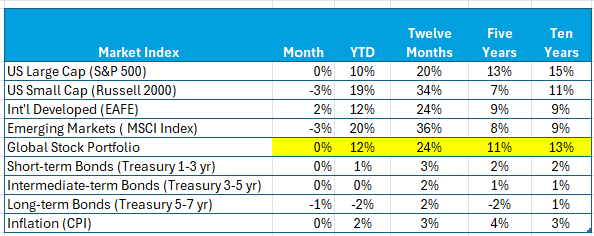
Here’s the data:
Stocks
Stocks seemingly move on the latest news from Iran negotiations and the status of the Strait of Hormuz. Consequently, since negotiations are off and on, expected continued volatility is demonstrated by the positive results in the first few trading days of August. Trying to predict these ups and downs is a fool’s errand; they must be endured. This volatility is the risk from investing in stocks and explains why we should expect higher returns.
Large domestic stocks (S&P 500) were essentially flat this month and down in Emerging Markets. These results are driven primarily by AI-related stocks. Sharp declines in South Korean and Taiwan markets reflect a falloff in technology-related companies (Samsung, Sk-Hynix, and TSMS).
Looking beyond this month’s shortfalls, stocks continue to reward investors as returns in all stock market indices are up substantially over the year-to-date and twelve-month periods. However, returns at these levels are well above what can be reasonably expected in the long run. In the meantime, appreciate these periods.
Positive returns over longer periods in US markets signal expected benefits of AI technology, primarily.
Bonds
Bond yields climbed this month in response to increased uncertainty, due to the on again/off again bombing of Iran, tariff policies, energy prices, and inflation. Expected inflation over five- and ten-year periods, as reflected in the spread between nominal and inflation-adjusted yields of 2.3%, remains close to the Fed’s 2% target.
The Fed met this month and decided to keep rates where they are. This news was not greeted positively by stocks markets – the S&P was 500 down 1.5%. Some argue that this is indicative of a lack of will to fight inflation, which at 3% over the trailing twelve months is above its target. We’ll see.
Magnificent Seven Valuation
While there is some variability among the returns of the stocks that make up the Magnificent Seven (Amazon, Apple, Google, Meta, Microsoft, Nivida, and Tesla) portfolio, it can be a reasonable proxy for the stock market’s response to the benefits of AI. From the first of the year, the value of an equally weighted portfolio of these stocks went down by about 1%, which prompts a review of the market’s valuation metrics.
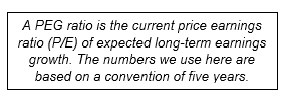
We look specifically at changes since June 2025, of the average PEG ratio of the Magnificent Seven portfolio minus Tesla, which is an outlier. A ratio of 1.0 is considered fully valued. While it is easy to quarrel with this methodology and assumption, it is useful to examine the impact of the retrenchment on market values.
While the considerable variability among the PEG ratio of the six remaining Magnificent Seven stocks, (from .5 for Nivida to 2.5 for Apple) the PEG for the portfolio is 1.2, close to fully valued. This is down from the comparable 2.1 ratio (signaling “overvalued”) a year ago. While I don’t want to build a “cathedral” around this analysis it does provide some evidence of a reassessment of the market value of these AI companies over the past year. hown up in the spread between nominal and inflation adjusted yields – remained at about 2.2%.